
A depreciating dollar and the uncertainty in the equity markets globally are adding to the sheen of the yellow metal. With gold prices surging 20 per cent in the last two months, Gold ETFs are back in focus.

Aimed at curbing gold imports and relying more on domestic supply, the government on Monday linked Gold ETF with gold deposit scheme.

Goldman Sachs expects gold to reach $3,150 per ounce in the international market by December 2025, up around 19.1 per cent from its current level of $2,645, according to a recent report in Business Standard. Domestically, gold is trading at Rs 76,018 per 10 grams after delivering a remarkable 21.9 per cent return in the past year.
According to the latest statistics from the Association of Mutual Funds of India, gold ETFs have lost 18 per cent of their investor base since May.

Inflows into mutual funds' equity schemes increased by over 14 per cent on-month to Rs 41,156 crore in December, even as market volatilities continued. The small and midcap schemes of mutual funds continued to attract investor interest with inflows touching record highs during the month, despite the concerns being expressed about the two segments for the risk they portend, industry body Amfi said.
The trend is expected to continue for a couple of months. But that hardly moves investors. Confusion, lack of knowledge and unpredictability are some reasons for gold ETF not pickling up as an investment option in India, market pundits say. The idea of gold ETF was first officially conceptualized by Benchmark Asset Management Company in India when it filed a proposal with the SEBI in May 2002.
Gold as an asset class has shown its mettle in the last one year. Especially in the past six months when the equity markets have been on a downslide, this yellow metal has continued to move northwards. And the numbers are there for all to see.

Geopolitical tensions in different parts of the globe and slowdown in global economy led investors to opt for safe-haven like gold over the last one year.
Benchmark Assent Management Company, a Mumbai-based mutual fund house, has listed India's first gold exchange traded fund (EFT) Gold BeES on the National Stock Exchange on Monday.
As the Indian stock market gyrates to the tune of global uncertainties, investors are looking out to invest their moneys in safe haven. Gold, in virtual form, can obviously be one of those safe havens. But if you are not convinced here are 7 reasons why you must invest in gold exchange traded funds.

Gold prices surged Rs 2,200 to hit a fresh peak of Rs 116,200 per 10 grams in the national capital on Monday buoyed by strong global cues as investors awaited key commentary from US Fed officials for policy direction. According to the All India Sarafa Association, the precious metal of 99.9 per cent purity had closed at Rs 1,14,000 per 10 grams on Friday.

All investors should ideally have a 10 to 15 per cent allocation to gold. Whether they invest in gold ETFs or SGBs should depend on their investment horizon.

The net inflow in equity mutual funds plunged 76 per cent to Rs 2,258 crore in November over the preceding month amid a sharp up move in the stock market that made investors wary of higher valuation. This also marks the 21st straight month of inflows into equity schemes. Overall, the mutual fund industry registered net inflows of Rs 13,263 crore in November, slightly lower from Rs 14,045 crore seen in the previous month, data released by the Association of Mutual Funds in India (Amfi) showed on Friday.
With a weak US dollar, rising commodity prices, rising interest rates and falling stock markets is this the right time to invest your money in gold?

Most investors should have a 5% to 10% allocation to gold for diversification. They should stagger their investments to mitigate timing risk.

'A 10 to 15 per cent allocation to gold in portfolios reduces risk without compromising on potential returns.'

Gold prices on Tuesday surged Rs 723 to touch an all-time high of Rs 110,312 per 10 grams in the domestic futures market, tracking strong global cues amid growing expectations of a US Federal Reserve interest rate cut next week. Traders said weak US labour market data has strengthened the case for monetary policy easing, putting pressure on the dollar and boosting demand for the safe-haven asset.

In 2022, gold emerged as the top performer among all conventional asset classes with over 14 per cent returns mainly owing to the depreciation of the rupee.

'AUM reached an all-time high of Rs 79.9 trillion in October 2025, driven by strong retail participation and record SIP inflows of Rs 29,529 crore from over 94.5 million contributing accounts.'

'New investors should enter gradually and stay cautious.' 'Silver is a structural multi-year story, but timing matters in a high-volatility metal.'

Silver prices extended their record-breaking rally for a sixth straight session on Monday, surging 6 per cent to touch a lifetime high of Rs 2,54,174 per kilogram in futures trade amid strong investor demand and bullish global trends. On the Multi Commodity Exchange (MCX), silver futures for March delivery surged Rs 14,387, or 6 per cent, to hit a new record of Rs 2,54,174 per kilogram.

'If gold's recent surge has increased its allocation beyond 15 per cent in your portfolio, now may be a good time to rebalance.'

The Reserve Bank of India (RBI) on Wednesday came out with comprehensive draft guidelines to harmonise and regulate gold loans across all financial entities, including putting a cap of 75 per cent on loan-to-value (LTV) ratio. The draft guidelines also aim to address concerns related to certain lending practices, provide clarity on specific aspects, and strengthen the conduct-related standards in the sector.

The Indian metal market is a promising sector to invest in as it provides a good balance between the prospects of growth and stability in dynamic economic conditions and a changing geopolitical environment. Metals such as gold, silver, copper, etc, have gained renewed significance in 2025, amidst growing inflation and India's push towards infrastructural growth and green energy initiatives.
The Indian metal market is a promising sector to invest in as it provides a good balance between the prospects of growth and stability in dynamic economic conditions and a changing geopolitical environment. Metals such as gold, silver, copper, etc, have gained renewed significance in 2025, amidst growing inflation and India's push towards infrastructural growth and green energy initiatives.

Gold exchange traded funds (ETFs) witnessed a net outflow of Rs 199 crore in January, making it the third monthly withdrawal in a row, with investors preferring equities over other segments on buoyant record SIP flow. This was in comparison to a net outflow of Rs 273 crore registered in the segment in December and Rs 195 crore in November. Prior to that, Gold ETFs attracted Rs 147 crore in October, data with Association of Mutual Funds in India (Amfi) showed.
The surge in volatility across the globe sparked by Russian invasion of Ukraine has led to an increase in prices of gold and silver - considered to be safe-haven investment bets. In the past month, silver funds have delivered returns of 7.34 per cent, while gold funds on an average have risen around 6 per cent. In comparison, the benchmark Nifty has declined 4 per cent. Fund managers say precious commodities act as a good hedge against inflation and phases of geopolitical uncertainty.

'Investors' decisions should reflect their financial goals, risk tolerance, and the amount of gold already present in their portfolio.'

Investors must account for currency depreciation in their financial plans and use instruments that can cushion the erosion in purchasing power.

'It makes sense to have gold in one's portfolio keeping the political and economic risks of 2024 in mind.'

'...a mix of asset classes.' 'Include equities for growth (across market caps), debt for stability and liquidity, gold as a hedge against macro and currency risk, and global assets for geographical and economic diversification.'

New investors should enter gradually and with a long horizon. 'Staggered investment through systematic purchase plans is advisable rather than lump-sum buying.'

Understand the pros and cons of SGBs before rushing to invest in them based on past returns.

'It is the best avenue for investors who would like to take long-term exposure to gold.'

Rediff explains why the system, not the Budget, is the problem.
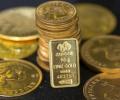
The best part is that an investor gets price appreciation and earns interest income as well, which is unique only to sovereign gold bond.

Investors pumped Rs 491 crore in gold exchange traded funds (ETFs) in February as they seem be taking advantage of the lower domestic prices caused due to declining international rates, appreciating rupee and reduction in custom duty. This came following a net investment of Rs 625 crore in January and Rs 431 crore in December. Prior to this, gold ETFs had seen an outflow of Rs 141 crore in November, data available with Association of Mutual Funds in India showed.

Apart from the emotional value attached to buying gold, the yellow metal offers protection against inflation, interest rate spikes, currency and geopolitical risks, says Anamika Pareek.
The government has sold SGBs worth Rs 1,990 crore in April and May alone.

It makes sense to wait for govt schemes such as gold bonds.
